Is Godzilla Real? Could a Monster That Big Actually Exist?
Quick answer
No. Godzilla is a fictional monster from Toho's 1954 film. Could an animal that big exist? With known biology, extremely unlikely. A film setting of 20,000 tons is about 74 of the largest blue whales, and the square-cube law means weight outgrows bone strength as a body gets bigger. No one has proven a hard limit, though.
In this article
Is Godzilla Real?
No. Godzilla is a fictional movie monster, and no fossil or living animal matches it. Toho's own company timeline lists Godzilla as a 1954 release, the first in the series.[1] The suit used in filming that first movie was only about 2 meters (6.6 feet) tall, according to a 2019 article in Japan's Weekly Gendai.[2] The character is still working, too: Godzilla Minus Zero has a North American release date of November 6, 2026.[3]
So could an animal that big exist? We ran no experiments, so what follows is published research plus arithmetic we label as our own.
How Much Does Godzilla Weigh?
It depends on the film, and every answer is a story setting, not a measurement. Here are the figures we could trace:
- Godzilla (1954): 50 meters (164 feet) tall in the story setting,[2] with 20,000 T listed on the official Godzilla site for the 1954 to 1975 era.[4]
- Godzilla Minus One (2023): 50.1 meters and 20,000 T on the same site.[5]
- Shin Godzilla (2016): 118.5 meters (389 feet), reported by Japanese film news in 2015.[6] We could not confirm a weight.
- Godzilla (2014, Legendary): "350 foot," in director Gareth Edwards's words.[7] We found no reliable weight.
The site doesn't say which ton "T" means, so we treat it as metric. Below, we assume 50 meters and 20,000 tons, the best-sourced pair.
What Is the Square-Cube Law?
The square-cube law says that when an object grows without changing shape, its area rises with the square of its size and its volume rises with the cube. Weight follows volume. The strength of a bone or muscle follows its cross-section, which is an area. A 1986 paper on land animal limits starts from the same logic: keep the shape constant and leg bone stress climbs until the leg fails.[8]
Make an animal twice as tall with the same shape, and its bones gain 4 times the area but must carry 8 times the weight.
Here is our own arithmetic for a body of the same shape, where load means weight divided by bone area:
| Height multiplied by | Bone area | Weight | Load on each bit of bone |
|---|---|---|---|
| 2 | 4 | 8 | 2 |
| 10 | 100 | 1,000 | 10 |
| 29.4 | 865 | about 25,400 | 29.4 |
That last row is a person scaled to Godzilla height, using round numbers we chose: 1.7 meters and 70 kilograms. Then 50 ÷ 1.7 ≈ 29.4, and 70 kilograms × 25,400 is about 1,780 metric tons, with bones under 29.4 times the usual load.

What Is the Biggest Dinosaur Ever, and the Largest Animal Ever?
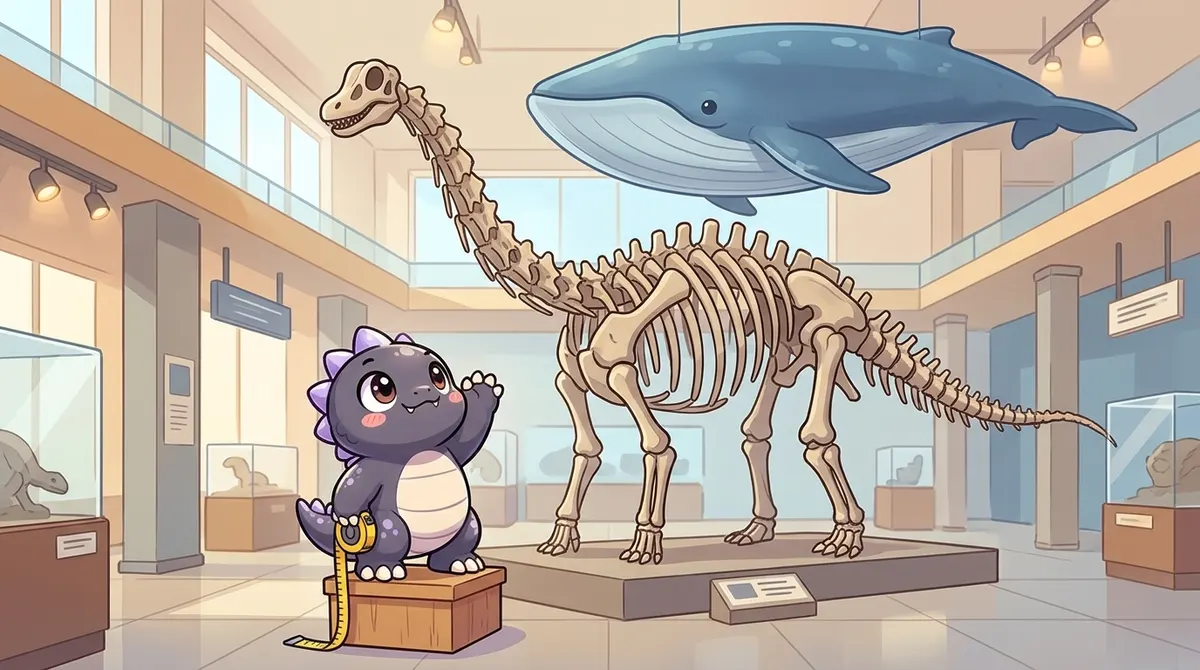
NOAA calls the blue whale the largest animal ever to live, at up to 110 feet and 330,000 pounds, which is about 150 metric tons.[9] A 2024 paper in PeerJ calculates that the longest whales reached about 270 tons and argues that the fossil whale Perucetus did not exceed them.[10]
The biggest dinosaur ever is not settled. Patagotitan gave a limb-bone estimate of 69 tonnes, plus or minus 17, and 3D body models of 45, 51 and 77 tonnes.[11] Published estimates for Argentinosaurus run from 70 to 90 tonnes,[12] but it has no limb bones to use in that equation.[11] Paleontologist Mathew Wedel called the contest closer to a three-way tie that also includes Puertasaurus.[13]
| Animal or setting | Mass | What kind of number is it? |
|---|---|---|
| Blue whale, 27.1 meters (89 feet)[10] | At least 136.4 tons | Weighed in pieces, a minimum |
| Blue whale, 33 meters (108 feet)[10] | About 270 tons (one range: 201 to 342) | Calculated from length |
| Patagotitan[11] | 69 tonnes ± 17 | Estimated from limb bones |
| Argentinosaurus[12] | 70 to 90 tonnes | Published estimates |
| Godzilla, 1954 to 1975 era[4] | 20,000 T | Fiction, not a measurement |
Even the real numbers are soft. Researchers behind a 2020 review note that estimates for T. rex alone have ranged from about 3 to over 18 tonnes.[14]
Our arithmetic: 20,000 ÷ 270 is about 74 of the largest blue whales, and 20,000 ÷ 69 is about 290 Patagotitan.
Why Can Whales Outgrow Dinosaurs?
The classic answer is buoyancy. People have argued since Galileo in the 1630s that water supports a whale, and that a land animal of the same weight would be crushed.[8] Buoyancy does ease the load on a skeleton, but that does not remove the limit.
A 2018 study of 3,859 living and 2,999 fossil mammal species found that water imposes tighter size constraints than land does, with feeding efficiency setting the maximum.[15] A 2019 study in Science concluded that the maximum size of filter feeders is likely constrained by prey availability.[16] Water seems to change which limit a giant hits first, from holding itself up toward finding enough food. That is our summary.
Could Bones and Muscles Carry Godzilla?
This is where "about 1,000 tons" comes from. J.E.I. Hokkanen's 1986 paper in the Journal of Theoretical Biology suggests an upper limit for land animals between 100 and 1,000 metric tons, using scaling rules for bone and muscle.[8] His bone calculation gives 140 tons, with a safety factor of 10 that he chose. Lowering that factor to 5 raises the result about tenfold.
It is not a law of nature. Hokkanen extrapolated from mammals, called the method "always uncertain," and did not rule out heavier animals with new adaptations.[8] Such limits have moved before: one proposal capped land animals at 20 tons, and sauropods blew past it, as a 2011 review notes.[12]
Still, 20,000 tons is 20 times the top of his range. Here is our own static estimate for the legs, using the 170 megapascal bone strength he cites and his safety factor of 10:
- Weight: 20,000,000 kilograms × 9.81 ≈ 196 million newtons
- On two legs: about 98 million newtons each
- Bone area per leg: 98 million ÷ 170 million × 10 ≈ 5.8 square meters, or a solid column about 2.7 meters (9 feet) wide
That column alone isn't absurd, which is why we won't say "impossible." The catch is movement. Our sum ignores bending, the main stress in motion, and Hokkanen warns that an animal with much thicker bones could not move. His speed formula gives only about 6 kilometers per hour (3.7 mph) at 1,000 tons.
What About Heat, Blood and Breathing?
Heat. One model found that a sauropod over 10 tonnes would hit lethal body temperatures without some way to cool down. The 2011 review cautions that the model used unrealistically high growth rates, and suggests the air sac system may have helped with cooling.[12]

Blood. The same review cites an estimate of a 200-kilogram heart for a 38-tonne Brachiosaurus, and notes that some researchers doubt sauropods could habitually hold their necks upright.[12] In a 2019 tagging study, blue whale hearts reached 25 to 37 beats per minute after dives, near the estimated maximum.[17] Our arithmetic for a 50-meter animal, with the heart halfway up and blood about as dense as water: a 25-meter column pushes back with about 2.4 atmospheres.
Breathing. Much of the sauropod backbone was filled with air spaces, which researchers read as a sign of bird-style flow-through lungs and large air sacs.[12] We found nothing that tests this at 20,000 tons.
Food. Hokkanen also notes that no ecosystem can support many huge animals, and that big animals are slow to replace their losses.[8]
With known biology, an animal the size of film Godzilla is extremely unlikely, even though nobody has proven a hard limit.
Myths vs Facts
| Myth | Fact |
|---|---|
| Godzilla is based on a real, measured animal. | Godzilla is a film character from Toho, first released in 1954.[1] Its sizes are settings that change by film.[2] |
| Science has proven a 1,000-ton limit for land animals. | That figure is the top of one 1986 estimate of 100 to 1,000 tons, which allowed for heavier animals with new adaptations.[8] |
| Whales are big simply because water holds them up. | Recent work points to feeding and prey supply as the ceiling, and finds water does not free mammals from size limits.[15][16] |
What We Still Can't Tell You
We can't give a true maximum size for a land animal. Hokkanen extrapolates from mostly moderate-sized mammals, and his muscle estimate assumes four legs, not an upright two-legged giant. We found no peer-reviewed analysis of Godzilla itself, and our sums are simple statics, not a simulation.
We also found no verifiable Toho or Legendary weight for the 2016 or 2014 films. The whale paper writes "tons" without defining them, so our comparisons are rounded. And we can't rule out adaptations nobody has imagined, which is why we say "extremely unlikely" rather than "impossible."
Godzilla is a trademark of Toho Co., Ltd. This article is independent commentary and is not affiliated with or endorsed by Toho.
Frequently Asked Questions
How much does Godzilla weigh?
It depends on the film, and every figure is a story setting. The official Godzilla site lists 20,000 T for the 1954 to 1975 era and for Godzilla Minus One. We could not verify a weight for the 2014 or 2016 films.
What is the square-cube law?
When something grows without changing shape, its area rises with the square of its size and its volume with the cube. Twice as tall means 4 times the bone area but 8 times the weight, so each bit of bone carries twice the load.
What is the biggest dinosaur ever?
It is not settled. Patagotitan and Argentinosaurus are leading candidates, with published estimates around 70 tonnes or more and wide uncertainty, because mass has to be inferred from incomplete bones.
What is the largest animal ever?
The blue whale, according to NOAA. NOAA lists up to 330,000 pounds, and a 2024 paper calculates about 270 tons for the longest whales ever measured.
References
- History. TOHO Co., Ltd.. Accessed Nov 2, 2026.Supports: Toho's company timeline lists Godzilla as released in 1954, the first in the Godzilla series, and lists Shin Godzilla (2016) and Godzilla Minus One (2023).
- ゴジラがこの四半世紀で50mも「身長が伸びた」ワケ. Gendai Business (Weekly Gendai), Kodansha (2019). Accessed Nov 2, 2026.Supports: In the 1954 film Godzilla's height was set at 50 meters; the suit used in filming was only 2 meters tall; the setting grew in later films, up to 118.5 meters in Shin Godzilla.
- TOHO and GKIDS Unleash GODZILLA MINUS ZERO in North America on November 6, 2026. GKIDS (2026). Accessed Nov 2, 2026.Supports: Wide theatrical release across North America begins November 6, 2026.
- The King Godzilla (1954-1975). Godzilla.com, official site (TM & © Toho). Accessed Nov 2, 2026.Supports: Monsterpedia entry listing Largest Height 50 Meters and Largest Weight 20,000 T for the 1954 to 1975 era. Film setting, not a measurement.
- Godzilla Minus One Godzilla (2023). Godzilla.com, official site (TM & © Toho). Accessed Nov 2, 2026.Supports: Monsterpedia entry listing Largest Height 50.1 Meters and Largest Weight 20,000 T. Film setting, not a measurement.
- 庵野版「ゴジラ」16年7月29日公開決定!シリーズ最大118.5メートルのゴジラが誕生. eiga.com (2015). Accessed Nov 2, 2026.Supports: Reports that the Godzilla in the then-upcoming film is 118.5 meters, the largest in the series.
- Molina M. 'Godzilla': Director Gareth Edwards Exclusive Interview. Showbiz Junkies (2014). Accessed Nov 2, 2026.Supports: Director Gareth Edwards: 'our Godzilla is 350 foot.'
- Hokkanen JEI. The size of the largest land animal. Journal of Theoretical Biology (copy read at miketaylor.org.uk) (1986). Accessed Nov 2, 2026.Supports: Suggests an upper mass limit for land animals between 10^5 and 10^6 kg from bone and muscle scaling and locomotion; bone calculation gives 1.4 x 10^5 kg with a safety factor of 10; a higher mass with new adaptations is not excluded; bone compressive strength about 170 MPa; 10^6 kg allows about 6 km/h.
- Blue Whale. NOAA Fisheries. Accessed Nov 2, 2026.Supports: Blue whales grow up to 110 feet and 330,000 pounds and are the largest animals ever to live on our planet.
- Motani R, Pyenson ND. Downsizing a heavyweight: factors and methods that revise weight estimates of the giant fossil whale Perucetus colossus. PeerJ (2024). Accessed Nov 2, 2026.Supports: Perucetus did not exceed the body mass of blue whales; largest blue whales are in the vicinity of 270 tons (regression interval 201 to 342 for a 33 m whale); a 27.1 m female weighed at least 136.4 tons piecemeal.
- Carballido JL, Pol D, Otero A, et al.. A new giant titanosaur sheds light on body mass evolution among sauropod dinosaurs. Proceedings of the Royal Society B (2017). Accessed Nov 2, 2026.Supports: Patagotitan scaling estimate 69 tonnes (standard error 17); volumetric models 45, 51 and 77 tonnes; Argentinosaurus cannot be estimated with scaling equations because limb elements are absent; uncertainties are notably large.
- Sander PM, Christian A, Clauss M, et al.. Biology of the sauropod dinosaurs: the evolution of gigantism. Biological Reviews (2011). Accessed Nov 2, 2026.Supports: Published Argentinosaurus estimates of 70 to 90 t; a 20 t gravity limit was proposed and exceeded by sauropods; model of lethal temperatures above 10 t, with caveat; air sacs as possible cooling; 200 kg heart estimated for a 38 t Brachiosaurus; debate on upright necks; pneumatized skeleton indicating flow-through lung and air sacs.
- Dwyer C. This Could Be The Biggest Dinosaur Ever Found, And It's Finally Got A Name. NPR, republished by KPBS (2017). Accessed Nov 2, 2026.Supports: Mathew Wedel argues the contest is closer to a three-way tie among Patagotitan, Argentinosaurus and Puertasaurus.
- How to Weigh a Dinosaur. Royal Ontario Museum (2020). Accessed Nov 2, 2026.Supports: News release on Campione and Evans 2020: researchers stress incorporating uncertainty in mass estimates; T. rex estimates have ranged from about 3 to over 18 tonnes.
- Gearty W, McClain CR, Payne JL. Energetic tradeoffs control the size distribution of aquatic mammals. PNAS (2018). Accessed Nov 2, 2026.Supports: From 3,859 living and 2,999 fossil mammal species: the aquatic realm imposes tighter constraints on size than the terrestrial realm, and limits on feeding efficiency constrain maximum size.
- Goldbogen JA, Cade DE, Wisniewska DM, et al.. Why whales are big but not bigger: physiological drivers and ecological limits in the age of ocean giants. Science (abstract read at University of St Andrews research portal) (2019). Accessed Nov 2, 2026.Supports: Maximum size in filter feeders is likely constrained by prey availability across space and time.
- Goldbogen JA, Cade DE, Calambokidis J, et al.. Extreme bradycardia and tachycardia in the world's largest animal. PNAS (abstract read at NOAA Institutional Repository) (2019). Accessed Nov 2, 2026.Supports: After-dive surface heart rates of blue whales were 25 to 37 bpm, near the estimated maximum heart rate possible.

Dr. Pippa is a fictional animated character who guides you through the science. She is not a real doctor or researcher.