What If the Moon Disappeared?
Quick answer
In this thought experiment, the first day brings tides about a third the size of today's spring tides and much darker nights. Animals that use moonlight would have to cope. Models suggest Earth's tilt would wander more over millions of years, though how far is debated, and days would keep lengthening, only more slowly.
In this article
First, the Rules of This Thought Experiment
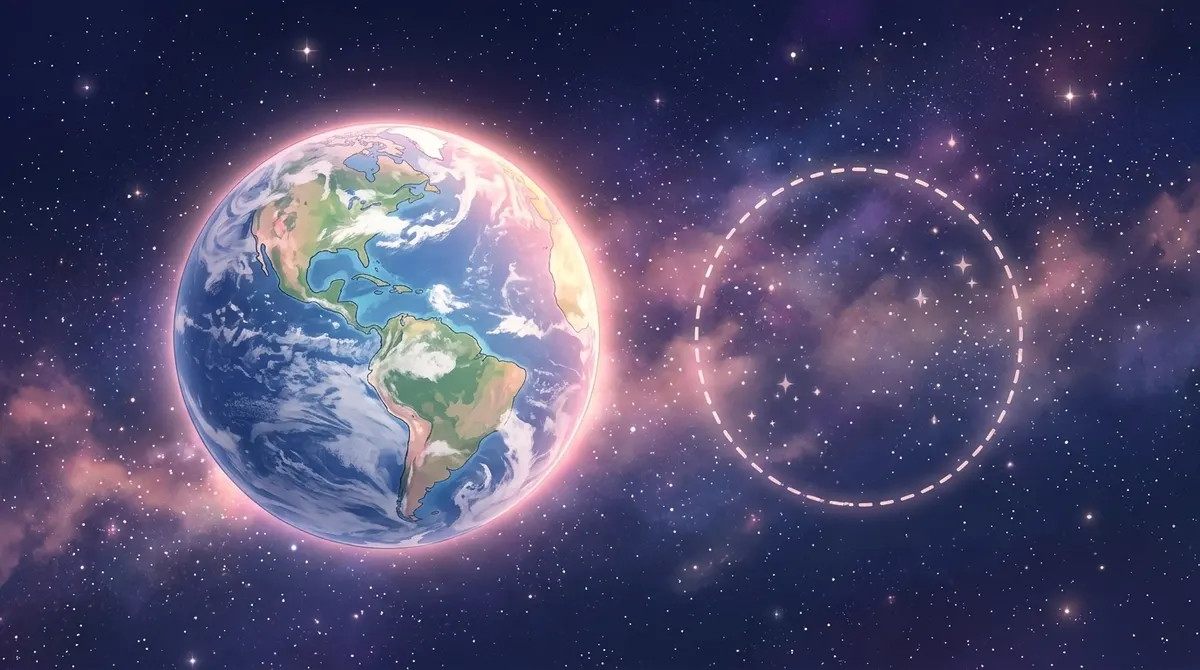
What if the moon disappeared? This is a thought experiment, not a prediction. We assume:
- The Moon vanishes all at once, along with its gravity and its light. No debris, no flash.
- Earth keeps the spin, tilt and orbit it has at that moment.
The first day would bring smaller tides and much darker nights, not a catastrophe. The slowest changes, to Earth's tilt and day length, would take millions of years or more.
| When | What changes | How solid is it? |
|---|---|---|
| First day | Tides shrink to about the Sun's share | Physics is solid; size varies by coast |
| First night | Nights get much darker | Solid |
| Years onward | Moonlight-using animals must cope | Speculative |
| Millions of years | Tilt wanders more | Modeled and debated |
| Hundreds of millions of years | Days lengthen more slowly | Our rough arithmetic |
How Would the Tides Change?
The Sun raises tides too, so they would not stop. NOAA says solar tides are about half as large as lunar tides.[1] The Sun has far more mass, but it is about 390 times farther away, and tide-generating force falls with the cube of distance.[2] An oceanography text puts the Sun's force at 46 percent of the Moon's.[6]
Today the two effects add at new and full Moon, giving spring tides, and partly cancel a week later, giving neap tides.[1] Here is our own idealized arithmetic, with the Moon's share as 1 and the Sun's as 0.46:
- Spring tide today: 1 + 0.46 = 1.46
- Neap tide today: 1 − 0.46 = 0.54
- Sun alone: 0.46
That leaves a tide about a third the size of today's spring tide (0.46 ÷ 1.46 ≈ 0.32), and a little under today's neap tide. An American Institute of Physics article also says about one-third.[7] Real coasts will not follow that sum neatly, because continents break tides into complex patterns within each basin.[4]
The rhythm would change as well. High tides now come 12 hours and 25 minutes apart because they track a lunar day of 24 hours and 50 minutes.[3] We infer that Sun-only tides would follow the 24-hour solar day, with no spring-neap cycle. We also infer a narrower intertidal zone, the strip between high and low tide where barnacles, sea stars and anemones each live at particular heights.[5]
How Much Darker Would Nights Get?
Most full Moons at mid-latitudes deliver 0.05 to 0.2 lux. Natural background light from airglow, stars and the Milky Way is in the millilux range.[8] Taking 1 millilux (0.001 lux) as a round figure, a full-Moon night is roughly 50 to 200 times brighter than the background alone. That is our estimate, not a measurement. Without the Moon, every clear night away from city lights would stay at that background level.
What About Animals That Use Moonlight?
We can say what animals use moonlight for today. What they would do without it is speculative.
Dung beetles. One African species holds a straight course using the polarization pattern of the moonlit sky, a million times dimmer than the Sun's.[9] But many dung beetles still roll straight on clear moonless nights by using the Milky Way, and they lose that ability under overcast skies.[10] They might lose one compass and keep another.
Corals. In a study of Acropora millepora on the Great Barrier Reef, colonies under natural moonlight spawned, while colonies kept dark from sunset to sunrise did not. The authors say changes in moonlight intensity trigger spawning in more than 130 coral species.[11] That points to a real risk for reef spawning, but it was one species in a short experiment, so we can't say whether corals would adapt.
Night-active mammals. A meta-analysis of 59 species found moonlight cut activity by 13.6 percent overall. Rodents, rabbits and hares, bats and carnivores tended to become less active, and primates more active.[12] We infer that permanent darkness would help some species and hurt others.
Would Earth's Tilt Go Wild?
Earth's axis is tilted 23.4 degrees. Over the last million years it has stayed between 22.1 and 24.5 degrees, in a cycle of about 41,000 years, and tilt is what gives us seasons.[13]
The research on a moonless Earth has been revised, and all of it is modeling:
- 1993: Laskar and colleagues suggested a range of 0 to about 85 degrees, as a later paper summarizes it.[15]
- 2013: Lissauer and colleagues simulated up to 4 billion years. The tilt swung much more than the real Earth's over 100,000 years, but over hundreds of millions of years it typically stayed within a 20 to 25 degree range.[14]
- 2014: Li and Batygin found chaotic zones at 0 to 45 and 65 to 85 degrees, joined by a slow "bridge." They estimated millions of years to cross a zone and about 2 billion to cross the bridge, and said that lacking a large moon "should not be viewed as suggestive of extreme climate variations."[15]
These models agree the tilt would wander more, but how far it would go is unsettled.
Would Days Get Longer or Shorter?
By our reasoning, day length would not jump, because removing the Moon does not suddenly change how fast Earth spins. Tidal friction slows that spin today. It predicts a day growing by 2.3 milliseconds per century, while the measured average is 1.8, with other effects making up the difference.[16]
The Sun's tides would keep braking Earth, more gently. One 2019 calculation puts the semidiurnal ocean tide torques at 4.462 × 10¹⁶ newton-meters from the Moon and 0.676 × 10¹⁶ from the Sun.[17] Our rough arithmetic, assuming constant rates:
- Sun's share: 0.676 ÷ 5.138 ≈ 13 percent, so 2.3 × 0.13 ≈ 0.3 milliseconds per century
- One extra hour (3.6 million milliseconds) at 2.3: about 160 million years
- One extra hour at 0.3: about 1.2 billion years
Curious how gravity shapes an orbit? Try our Gravity Simulator and change the mass, distance and speed yourself.
Myths vs Facts
| Myth | Fact |
|---|---|
| Earth would fly out of orbit. | The Sun's pull on Earth is more than 177 times the Moon's.[2] |
| Days would snap to 6 to 12 hours. | That figure describes an Earth never slowed by a Moon.[7] Today's braking is milliseconds per century.[16] |
| The axis would flip right away. | Models put big tilt changes on timescales of millions of years or longer.[15] |
What We Still Can't Tell You
We ran no experiments or simulations. Everything here comes from the sources cited, plus arithmetic and inferences we have labeled as ours.
The tilt papers model an Earth without a Moon, not a Moon deleted overnight, and they simplify the physics. We can't tell you what the tilt would be after a billion years, or what the tide would do at your local beach.
Our day-length arithmetic is a rough scale, not a forecast. We found no published figure for how fast a Sun-only Earth would slow from today's spin. And no experiment has removed the Moon, so the beetle and coral studies can't show what thousands of generations without it would do.
Frequently Asked Questions
Would there still be tides without the Moon?
Yes. The Sun also raises tides. NOAA says solar tides are about half as large as lunar tides, so tides would be smaller but would not stop.
Would Earth stop spinning if the Moon disappeared?
No. The Moon's tides slow Earth's spin very gradually, by a tiny amount each century. Losing them would mean a slower rate of slowing, not a stop.
Would we lose the seasons?
Not right away. Seasons come from Earth's tilt, and models of a moonless Earth put big tilt changes on timescales of millions of years or longer. How far the tilt would wander is still debated.
References
- Tidal Variations: The Influence of Position and Distance. NOAA National Ocean Service. Accessed Nov 1, 2026.Supports: Solar tides are about half as large as lunar tides; the Sun's effect adds at new and full Moon to give spring tides and partly cancels about a week later to give neap tides.
- What Causes Tides?. NOAA National Ocean Service. Accessed Nov 1, 2026.Supports: Tide-generating force falls with the cube of distance; the Sun is about 390 times farther than the Moon; the Sun's gravitational attraction to Earth is more than 177 times that of the Moon.
- Frequency of Tides: The Lunar Day. NOAA National Ocean Service. Accessed Nov 1, 2026.Supports: A lunar day is 24 hours and 50 minutes; high tides occur 12 hours and 25 minutes apart.
- Why Tide Timing and Height Vary Around the World. NOAA National Ocean Service. Accessed Nov 1, 2026.Supports: Continents interrupt tidal bulges, so tides set up complex patterns within each ocean basin.
- What is the intertidal zone?. NOAA National Ocean Service. Accessed Nov 1, 2026.Supports: The intertidal zone lies between high and low tides; species such as barnacles, sea stars and anemones settle at particular heights.
- Segar DA. 10.10: Chapter Summary, Introduction to Ocean Sciences. Geosciences LibreTexts, American Meteorological Society course text. Accessed Nov 1, 2026.Supports: Tide-generating forces exerted by the Sun are 46 percent as strong as those exerted by the Moon.
- Lewis M. What Would Happen If There Were No Moon?. Inside Science, American Institute of Physics (2015). Accessed Nov 1, 2026.Supports: Tides on a moonless Earth would be about one-third as high; a day without the Moon's long-term slowing would last six to twelve hours.
- Kyba CCM, Mohar A, Posch T. How bright is moonlight?. Astronomy & Geophysics (2017). Accessed Nov 1, 2026.Supports: Most full Moons at mid-latitudes give 0.05 to 0.2 lux; natural background from airglow, stars and the Milky Way is in the millilux range.
- Dacke M, Byrne MJ, Scholtz CH, Warrant EJ. Lunar orientation in a beetle. Proceedings of the Royal Society B (2004). Accessed Nov 1, 2026.Supports: The dung beetle Scarabaeus zambesianus orients using the million times dimmer polarization pattern of the moonlit sky.
- Dacke M, Baird E, Byrne M, Scholtz CH, Warrant EJ. Dung Beetles Use the Milky Way for Orientation. Current Biology (2013). Accessed Nov 1, 2026.Supports: Even on clear moonless nights many dung beetles orient along straight paths using the Milky Way; they lose this ability under overcast conditions.
- Kaniewska P, Alon S, Karako-Lampert S, Hoegh-Guldberg O, Levy O. Signaling cascades and the importance of moonlight in coral broadcast mass spawning. eLife (2015). Accessed Nov 1, 2026.Supports: Acropora millepora under ambient moonlight spawned while colonies kept dark from sunset to sunrise did not; moonlight intensity changes trigger spawning in more than 130 coral species.
- Prugh LR, Golden CD. Data from: Does moonlight increase predation risk? Meta-analysis reveals divergent responses of nocturnal mammals to lunar cycles. Dryad; paper in Journal of Animal Ecology (2014). Accessed Nov 1, 2026.Supports: Across 59 nocturnal mammal species, moonlight reduced activity by 13.6 percent; primates tended to become more active, while rodents, lagomorphs, bats and carnivores tended to become less active.
- Milankovitch (Orbital) Cycles and Their Role in Earth's Climate. NASA Science. Accessed Nov 1, 2026.Supports: Earth's axis is tilted 23.4 degrees; over the last million years it varied between 22.1 and 24.5 degrees in a cycle of about 41,000 years; obliquity is why Earth has seasons.
- Lissauer JJ, Barnes JW, Chambers JE. Rotation of a Moonless Earth. NASA Technical Reports Server; abstract for the American Geophysical Union Fall Meeting (2013). Accessed Nov 1, 2026.Supports: Simulations up to 4 billion years: moonless-Earth tilt varies much more than the real Earth's over 100,000 years but typically stays within a 20 to 25 degree range over hundreds of millions of years.
- Li G, Batygin K. On the Spin-axis Dynamics of a Moonless Earth. The Astrophysical Journal (arXiv version read) (2014). Accessed Nov 1, 2026.Supports: Summarizes Laskar et al. 1993 (0 to about 85 degrees without the Moon); finds chaotic zones at 0 to 45 and 65 to 85 degrees joined by a slower bridge, with crossing times of millions of years and about 2 billion years; concludes that absence of a large Moon should not be viewed as suggesting extreme climate variations.
- Stephenson FR, Morrison LV, Hohenkerk CY. Measurement of the Earth's rotation: 720 BC to AD 2015. Proceedings of the Royal Society A (2016). Accessed Nov 1, 2026.Supports: The length of the mean solar day increases at an average rate of 1.8 milliseconds per century, less than the 2.3 milliseconds per century predicted from tidal friction.
- Na, Shen, Cho and colleagues. Earth rotation deceleration/acceleration due to semidiurnal oceanic/atmospheric tides: Revisited with new calculation. Geodesy and Geodynamics (2019). Accessed Nov 1, 2026.Supports: Semidiurnal oceanic lunar and solar tides exert decelerating torques of about 4.462 × 10^16 and 0.676 × 10^16 newton-meters. Seen only in a search excerpt.

Dr. Pippa is a fictional animated character who guides you through the science. She is not a real doctor or researcher.