What If the Earth Stopped Spinning?
Quick answer
It could not happen suddenly, but as a thought experiment: stop Earth all at once and air, water and loose objects keep moving east at up to about 1,040 mph (1,674 km/h). Stop it very slowly and, in a published model, oceans drift to the poles, land emerges around the equator, and one day and night together last about a year.
In this article
What Are We Assuming?
This is a thought experiment, not a prediction. Earth is not about to stop spinning, and it could not simply stop all at once. A University of Illinois physics Q&A says this "what if" couldn't happen, short of a collision with a very large object, which would be the bigger problem.[2]
These rules are our choices, not findings:
- "Stopped" means stopped against the distant stars. Earth keeps orbiting the Sun, and mass, gravity, tilt, air and water stay the same.
- A sudden stop takes a minute or less, and only the solid ground halts.
- A very slow stop takes years to billions of years, so nothing gets thrown.
How Fast Is the Ground Moving?
NASA lists Earth's equatorial radius as 6,378.137 km and its rotation against the stars as 23.9345 hours.[1] Our arithmetic:
- Circumference: 2 × π × 6,378.137 km ≈ 40,075 km (about 24,901 miles).
- Speed in km/h: 40,075 ÷ 23.9345 ≈ 1,674 km/h.
- Speed in mph: 24,901 ÷ 23.9345 ≈ 1,040 mph.
The ground at the equator moves at about 1,040 mph (1,674 km/h), or roughly 465 meters per second. The Smithsonian's How Things Fly site uses a rounder 1,100 mph.[4] Away from the equator the circle you ride gets smaller, so multiply by the cosine of latitude: about 736 mph (1,184 km/h) at 45°, also our arithmetic, and zero at the poles.
What Would a Sudden Stop Do?
This part is about inertia: a moving thing keeps moving until something pushes back. The ground stops, and whatever is not firmly attached does not. People would be flung eastward, the direction Earth turns.[5] The atmosphere would keep going, and land would be stripped of anything not anchored to bedrock, according to the Smithsonian.[4] Oceans would keep moving too, and BBC Science Focus says everything on the surface would be destroyed.[6]
Stretching the stop to a full minute does not save you. Losing 465 meters per second in 60 seconds is 7.75 m/s² by our math, about 0.79 of the 9.78 m/s² gravity NASA lists at the equator.[1] Science Focus rounds this to three-quarters of gravity and says "down" would feel tilted 38° from vertical, enough to knock over most buildings.[6]
What Would a Very Slow Stop Do to the Oceans?
Earth is slightly wider than it is tall: NASA's equatorial and polar radii differ by about 21 km (13 miles).[1] The outward effect of spin at the equator looks tiny. By our math, 465² ÷ 6,378,137 ≈ 0.034 m/s², about 0.35 percent of gravity there.
In 2010, Witold Fraczek of the mapping company Esri modeled the planet without that force.[7] We could not open Esri's original article, so this comes from reports about it. An excerpt published by Gizmodo says equatorial waters would move toward the poles and the northern ocean would spread over Siberia's lowlands and northern North America. The global ocean would eventually split in two.[8]
In this modeled world, Earth ends up with two polar oceans and a belt of land around its middle. Science Focus adds that ocean depth would drop by 8 km (about 5 miles) at the equator.[6]
How slow is gentle enough? The Smithsonian says the stripping of the land would not happen over billions of years,[4] while Science Focus says a slowdown over several years would still be a disaster.[6]
Why Would One Day Last About a Year?
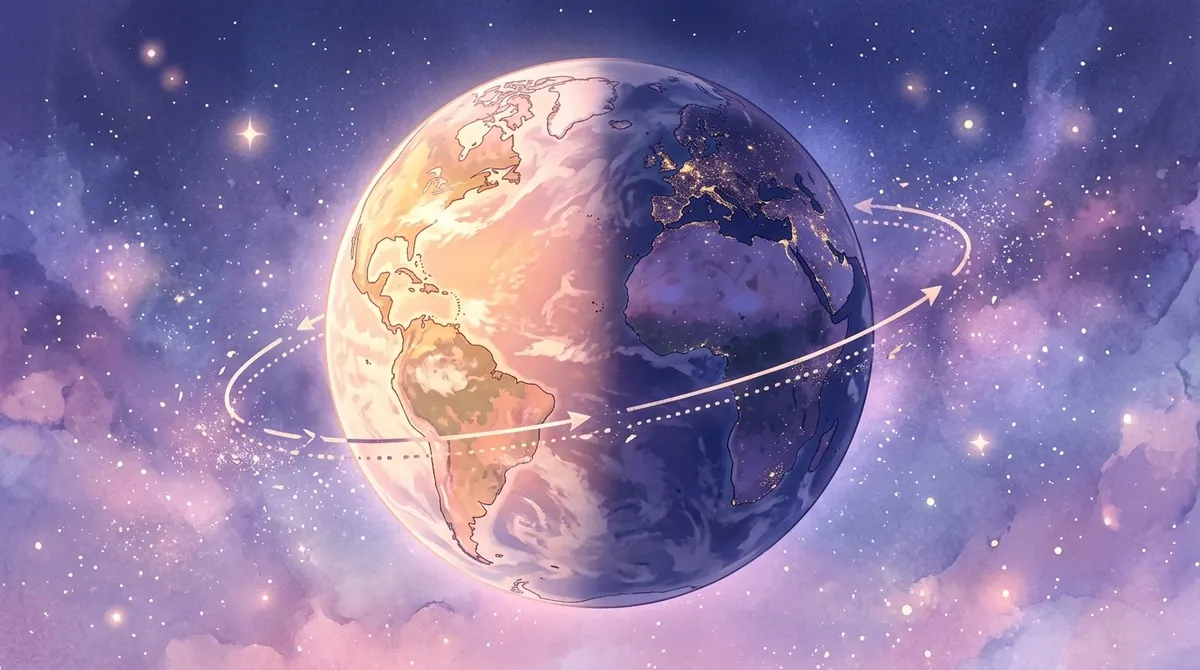
Earth would still circle the Sun, a trip NASA lists at about 365.24 days.[1] With no spin, the orbit alone would carry each place from sunlight into darkness and back. One full cycle of day and night would take about a year, with roughly six months of light and six months of dark.[4][6]
Two details are our own reasoning, not sourced findings: the Sun would drift slowly eastward across the sky, so it would rise in the west, and Earth's tilt would make the exact split vary by latitude.
What Would Happen to the Climate?
Most of this section is modeled or speculative. Today, Earth's rotation deflects moving air and water, which shapes winds and currents.[9] Without it, the Smithsonian expects air to flow from the equator toward the poles instead of running east and west.[4]
Temperature is where our sources disagree. Science Focus describes six months of sun heating the planet to well over 212°F (100°C).[6] Climate models of slow rotators point another way. In one 2014 study, long daylight built thick, reflective clouds on the sunlit side. With Earth's level of sunlight, global average surface temperature fell 20 K (36°F) going from a 1-day to a 256-day rotation, and another 25 K (45°F) for a tidally locked planet.[10] A NASA model of ancient Venus, with its 117-Earth-day day, also produced a sheltering cloud layer.[11]
No model we read tests this exact world, with polar oceans and a year-long day, so treat any temperature as speculation. The 2014 authors themselves warn that cloud modeling is difficult.[10]
What About the Magnetic Field?
The field is thought to come from convecting liquid metal in the outer core, driven mainly by Earth's cooling and differentiation, according to NASA.[12] Rotation still matters: Natural Resources Canada says rotation and convection together produce the needed flow pattern,[13] and physicists believe the Coriolis force is part of the core's main balance of forces.[14]
The Smithsonian expects a weaker field, and University of Kent planetary scientist Penny Wozniakiewicz says we may lose it.[4][5] We found no simulation of this case. Slow-spinning Venus has no detected dynamo, but one peer-reviewed paper points to heat flow and layering in its core, so Venus does not settle it.[15]
Could Earth Really Stop?
Not suddenly. Earth's spin is angular momentum that, as a University of Illinois physicist puts it, doesn't have anywhere to go.[3] Tides do slow it, gently: a NASA/JPL interview says a day will be about 2 milliseconds longer a century from now.[16] At that pace, ignoring any change in the rate, adding one hour would take 3,600 seconds ÷ 0.002 seconds per century = 1.8 million centuries, or 180 million years, by our math. And tidal friction would slow the spin without stopping it.[2]
Myths vs Facts
| Myth | Fact |
|---|---|
| We would all fly off into space. | The throw is sideways and gravity remains. Equator speed is about 0.465 km/s, roughly 4 percent of Earth's 11.186 km/s escape velocity.[1] |
| A stopped Earth has one side in endless day. | That is a planet tidally locked to the Sun, a different case.[5] Stopped against the stars, each place gets about half a year of light.[4] |
What We Still Can't Tell You
We can't tell you exactly what a stopped Earth would look like. We ran no experiments or models. Every number here comes from a cited source or arithmetic we showed. Some evidence is thin: Esri's model reaches you through news reports, and the 8 km figure and 38° tilt come from an unsigned magazine article.
We also found no readable source on how fast the solid planet's own bulge would relax. Our reasoning, not a finding, is that a slow enough stop would give rock time to settle too, which could shrink the ocean shift.
Frequently Asked Questions
How fast is the Earth spinning at the equator?
About 1,040 mph (1,674 km/h). That comes from a circumference of about 40,075 km divided by NASA's rotation period of 23.9345 hours. The speed falls with latitude and reaches zero at the poles.
Would we fly off into space if the Earth stopped spinning?
No. Gravity would still be there, and the throw would be sideways, not upward. In a sudden stop, unattached people and objects would keep moving east, which would be deadly but would not reach escape velocity.
How long would a day last if the Earth stopped spinning?
About a year for one full cycle of day and night, because Earth would still orbit the Sun. Most places would get roughly six months of light and six months of dark.
Could the Earth actually stop spinning?
Not suddenly. Tides do slow Earth's spin, but only by about 2 milliseconds per century, and that friction would slow the spin without stopping it.
References
- Williams DR. Earth Fact Sheet. NASA Goddard Space Flight Center, NSSDCA (2024). Accessed Nov 1, 2026.Supports: Equatorial radius 6378.137 km; polar radius 6356.752 km; sidereal rotation period 23.9345 hours; tropical orbit period 365.242 days; equatorial surface acceleration 9.780 m/s²; escape velocity 11.186 km/s.
- Mike W., Tom. Earth Stop Spinning?. Physics Van, University of Illinois (2007). Accessed Nov 1, 2026.Supports: This 'what if' couldn't happen except through a collision with a very large object, and that would be catastrophic; tidal friction would slow Earth's spin but would not stop it.
- Schmid D. What Keeps the Earth Spinning?. Physics Van, University of Illinois (2013). Accessed Nov 1, 2026.Supports: Earth started spinning during its formation, and that angular momentum doesn't have anywhere to go.
- If Earth stopped rotating on its axis, what would happen?. How Things Fly, Smithsonian National Air and Space Museum (2018). Accessed Nov 1, 2026.Supports: A sudden stop would leave the atmosphere moving at 1100 mph at the equator and strip land of anything not anchored to bedrock, though not if the stop took billions of years; a complete stop gives half a year of daylight and half a year of night; air would flow from equator to poles; the magnetic field would weaken.
- Wozniakiewicz P. What would happen if Earth stopped spinning?. BBC Sky at Night Magazine (2024). Accessed Nov 1, 2026.Supports: A University of Kent planetary scientist: an instant stop would fling people eastward; a gradual stop has gradual effects; loss of the magnetic field is possible; Earth would eventually become tidally locked with the Sun.
- The thought experiment: What would happen if the Earth stopped spinning?. BBC Science Focus Magazine. Accessed Nov 1, 2026.Supports: A sudden stop destroys everything on the surface; braking over a minute gives about three-quarters of gravity sideways and a 38° tilt; slowing over several years is still a disaster, with ocean depth dropping 8 km at the equator, two polar oceans and a central land belt; a day lasts a year; six months of daylight heats the planet to well over 100°C.
- Plumer B. The Day the Earth Stood Still. The New Republic (2010). Accessed Nov 1, 2026.Supports: Witold Fraczek of ESRI modeled what the planet would look like in the absence of centrifugal force; the oceans would move to the poles.
- Lamar C. This is what the Earth would look like if it stopped spinning. Gizmodo (2010). Accessed Nov 1, 2026.Supports: Excerpt of an ESRI projection: equatorial waters move toward polar areas; the northern ocean spreads over Siberian lowlands and northern North America; the global ocean eventually splits in two.
- Ocean currents. National Oceanic and Atmospheric Administration. Accessed Nov 1, 2026.Supports: Earth's rotation results in the Coriolis effect, which deflects winds and ocean waters from a straight path and influences ocean currents.
- Yang J, Boué G, Fabrycky DC, Abbot DS. Strong Dependence of the Inner Edge of the Habitable Zone on Planetary Rotation Rate. The Astrophysical Journal Letters (2014). Accessed Nov 1, 2026.Supports: In a 3D climate model, slow rotation and long daytime build thick dayside clouds that raise albedo; at Earth's sunlight with a 50 m mixed layer, global-mean surface temperature falls 20 K going from a 1-day to a 256-day rotation and another 25 K when tidally locked; cloud modeling is difficult and other models may differ.
- NASA Climate Modeling Suggests Venus May Have Been Habitable. NASA Goddard Institute for Space Studies (2016). Accessed Nov 1, 2026.Supports: A day on Venus is 117 Earth days; in the GISS model of ancient Venus, slow spin produced a thick layer of clouds that shielded the surface from much of the solar heating.
- Research Page: Geodynamo. NASA Goddard Space Flight Center. Accessed Nov 1, 2026.Supports: Earth's intrinsic magnetic field is conjectured to be generated by convective flow in the fluid outer core, driven mainly by gravitational energy from secular cooling and differentiation.
- Generation of the Earth's magnetic field. Natural Resources Canada (2019). Accessed Nov 1, 2026.Supports: The outer core is in constant motion due to both Earth's rotation and convection, which combine to produce the flow pattern needed to generate the field.
- Hughes DW, Cattaneo F. Strong field dynamo action in rapidly rotating convection with no inertia. Physical Review E (2016). Accessed Nov 1, 2026.Supports: The primary dynamical balance in Earth's core is believed to be between buoyancy, Coriolis and magnetic forces.
- Jacobson SA, Rubie DC, Hernlund J, Morbidelli A, Nakajima M. Formation, stratification, and mixing of the cores of Earth and Venus. Earth and Planetary Science Letters (2017). Accessed Nov 1, 2026.Supports: No trace of a dynamo has been detected on Venus; the paper discusses limited mantle heat flow and stable core stratification as explanations, and says the Coriolis force is non-negligible even on Venus.
- Space Place Musings: Why does Earth rotate?. New Millennium Program, NASA Jet Propulsion Laboratory. Accessed Nov 1, 2026.Supports: Tidal friction slows Earth's rotation; one hundred years from now, a day will be about 2 milliseconds longer than today.

Dr. Pippa is a fictional animated character who guides you through the science. She is not a real doctor or researcher.